
.png)
If you've been running your business's marketing yourself, stretching a small team across too many channels, or spending money on agencies without seeing a return that makes sense, you've probably started wondering whether there's a better model. Fractional marketing is the answer a growing number of businesses are landing on, and for good reason. This guide breaks down exactly what fractional marketing is, how it works, what it costs, and how to evaluate whether it's the right move for your business right now.
What Is Fractional Marketing?
Fractional marketing is a model where businesses bring in senior marketing professionals on a part-time, retainer, or project basis instead of hiring a full-time marketing team or executive. The word "fractional" means exactly what it sounds like: you get a fraction of a marketing leader's time, applied with full strategic depth, without carrying the full-time salary, benefits, and overhead that comes with a traditional hire.
This model has gained serious traction in the last few years, especially among small and mid-sized businesses that are growing past the point where the founder can keep managing marketing, but haven't yet reached the revenue level where a $250,000+ full-time CMO makes financial sense.
Fractional marketing can include a single fractional CMO who leads your strategy, a fractional marketing team that handles both strategy and execution, or a hybrid of both. The engagement is tailored to what the business needs at its current stage, and it scales up or down as those needs evolve.
Why Is Fractional Marketing Growing So Fast?
The fractional marketing model has moved from a niche concept to a mainstream business strategy, and the numbers reflect that shift. According to industry research compiled by Geisheker & Associates and GTM 80/20, the fractional CMO market reached an estimated $1.27 billion in 2026 and is projected to grow to $2.68 billion by 2031. Industry data suggests that roughly one in four U.S. companies has adopted some form of fractional leadership, with projections reaching 35% by the end of 2026.
Several forces are driving this growth at the same time.
Marketing has become deeply specialized. A single marketing generalist or even a strong marketing manager can no longer cover the breadth of channels, platforms, analytics tools, and strategic frameworks that modern growth requires. Search engine optimization, paid media, content strategy, email marketing, conversion rate optimization, social media, and marketing automation each require focused expertise. Fractional marketing gives businesses access to experts across these disciplines without building out an entire department.
Full-time marketing leadership has become expensive and increasingly hard to retain. According to Payscale and Glassdoor 2025 salary data, full-time CMOs command total compensation packages ranging from $250,000 to over $400,000 annually when you factor in base salary, bonuses, benefits, and equity. For businesses in the $1 million to $15 million revenue range, that level of investment in a single role is rarely sustainable. Fractional engagements typically run between $3,000 and $15,000 per month, representing an estimated 40 to 70 percent cost reduction while delivering the same caliber of strategic leadership.
Marketing budgets have tightened across the board. Gartner's CMO Spend Survey shows that CMO budget allocations dropped from 9.1% of revenue in 2023 to 7.7% in 2025, meaning businesses are under pressure to get more impact from less spend. That environment is tailor-made for the fractional model, where you pay for strategic output rather than keeping a bench of full-time employees on payroll.
The shift to remote and distributed work has also made this model logistically seamless. Businesses are already accustomed to collaborating with team members who are working from different locations, which makes integrating a fractional marketing leader into existing workflows far simpler than it would have been even five years ago.
How Fractional Marketing Works in Practice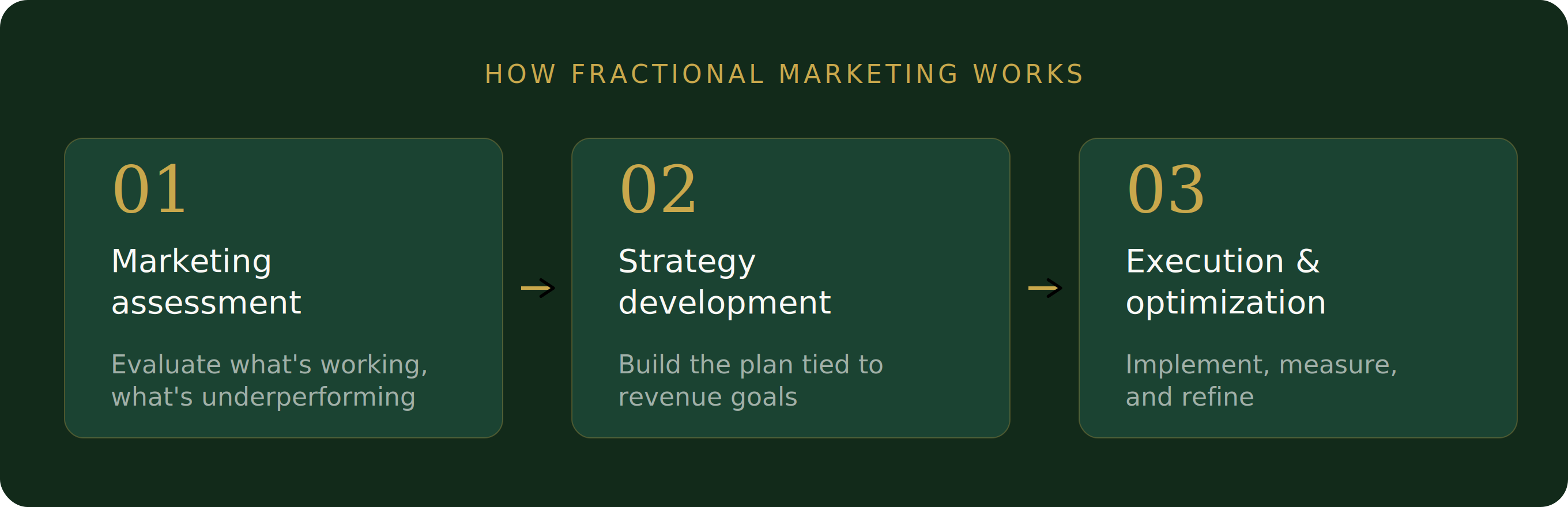 Step 1: Marketing Assessment
A fractional marketing leader starts by evaluating the current state of the business's marketing. This means looking at:
- What's working and producing results
- What's underperforming or stalled
- Where the gaps are in your channels, messaging, or audience targeting
- How (or whether) marketing is connecting to revenue
This assessment phase is critical because it establishes a strategic baseline rather than jumping straight into tactics. At Her Business Alliance, this is the foundation of our Marketing Friction Audit™, which identifies the specific points where your marketing is losing momentum or leaking potential customers.
Step 2: Strategy Development
From there, the fractional leader builds or refines the marketing strategy. This typically includes:
- Defining the target audience and ideal customer profile
- Clarifying brand positioning and messaging
- Mapping the customer journey from first touch to closed sale
- Identifying the highest-impact marketing channels for your business
- Setting measurable goals tied directly to business outcomes
The key distinction here is that the strategy is built around what the business needs to achieve financially, and marketing activities are designed to support those outcomes. Marketing for the sake of marketing metrics is precisely the problem fractional marketing is designed to solve.
Step 3: Execution and Optimization
Once strategy is in place, execution can happen in a few different ways:
- Some fractional marketing professionals focus exclusively on the strategic and leadership layer, guiding an internal team or managing agency partners to handle the tactical work.
- Others bring a team with them and provide both the strategic direction and the execution under one engagement.
- Some engagements start with strategy-only and expand into execution as the relationship develops.
The right structure depends on whether the business already has internal marketing resources, what the budget allows, and how hands-on the business needs the fractional leader to be.
Most fractional engagements involve somewhere between 10 and 30 hours per week, though some are structured as monthly retainers with deliverable milestones rather than tracked hours.
What Does a Fractional Marketing Team Include?
When people hear "fractional marketing," they often picture a single role, usually a fractional CMO. But the scope of what fractional marketing can cover is much broader than one title suggests. A strong fractional marketing engagement touches every layer of marketing leadership and execution that a business needs:
- Marketing strategy and leadership: Defining the overall marketing direction, brand positioning, budget allocation, and accountability for marketing's contribution to revenue. This includes sitting in on leadership meetings and functioning as a senior member of the team.
- Marketing planning: Building and refining the marketing plan, identifying the right channels, mapping campaigns, developing the content strategy, and aligning marketing activities with the sales pipeline.
- Content strategy and production: Leading the content direction across blog, social media, email, and other owned channels, ensuring everything is aligned, consistent, and producing measurable engagement.
- Digital marketing and performance: Managing performance-driven channels like paid search, paid social, SEO, and email automation, with a focus on lead generation, conversion optimization, and return on ad spend.
Some fractional marketing firms split these into separate roles or specialists. At Her Business Alliance, you get all of it through a single engagement. We handle the strategic direction, the planning, the content, and the performance marketing, so everything stays connected and nothing gets fragmented across multiple vendors or freelancers who aren't talking to each other.
Fractional Marketing vs. Agency vs. Consultant vs. In-House: How to Compare
One of the most common questions business owners ask is how fractional marketing stacks up against the other options they've considered. Each model serves a different function, and understanding where they overlap and where they diverge is essential to making the right investment..png?width=680&height=320&name=03-Comparison-Table-Fractional-vs-Agency-vs-Consultant-vs-InHouse%20(2).png) Fractional Marketing Leader / Team
Fractional Marketing Leader / Team
- Primary function: Strategic leadership, execution oversight, and hands-on implementation depending on the business's needs.
- Relationship to business: Embedded as part of the team. Participates in leadership discussions, owns marketing outcomes, and stays accountable over time.
- Cost range: $3,000 to $15,000 per month for a fractional CMO; team engagements vary based on scope.
- Best for: Businesses that need senior marketing direction and a cohesive strategy tied to revenue, with the flexibility to scale.
- Typical engagement: Ongoing retainer (month-to-month or quarterly), with most relationships lasting 12+ months.
- Key strength: Adapts to what the business has in place. At Her Business Alliance, if you have an internal team or agency partners, we provide the strategic direction, manage execution, and handle tasks that keep things flowing. If you don't have a team, we become your marketing department and handle both strategy and implementation directly.
Marketing Agency
- Primary function: Tactical execution of specific marketing deliverables (content production, ad management, design, social media, web development).
- Relationship to business: External vendor. Operates from a brief provided by the client and executes within a defined scope of work.
- Cost range: $2,000 to $20,000+ per month depending on services and agency tier.
- Best for: Businesses that already have a clear strategy and need production capacity to execute it.
- Typical engagement: Project-based or monthly retainer for specific deliverables.
- Key strength: Production capacity and specialization in specific tactical channels.
Marketing Consultant
- Primary function: Advisory and recommendations. Provides a strategy document, audit findings, or expert opinion.
- Relationship to business: External advisor. Delivers findings and recommendations, then steps away.
- Cost range: $150 to $400+ per hour or project-based fees.
- Best for: Businesses that need a one-time strategic assessment or outside perspective on a specific challenge.
- Typical engagement: Short-term (one to three months) or single-project.
- Key strength: Objective, external perspective without long-term commitment.
Full-Time In-House CMO / Marketing Team
- Primary function: Full ownership of all marketing strategy and execution as permanent employees.
- Relationship to business: Internal employee(s) on payroll. Fully embedded in company culture and operations.
- Cost range: $250,000 to $400,000+ annually for a CMO alone (salary, benefits, bonuses, equity). A full team adds $150,000 to $500,000+ depending on size.
- Best for: Companies with $10M+ revenue running complex, multi-channel marketing operations that require daily executive oversight.
- Typical engagement: Permanent employment.
- Key strength: Full-time availability and deep institutional knowledge built over years.
The comparison that matters most for growing businesses is understanding where each model fits in the lifecycle of your company. Many businesses in the $500K to $10M range find that they need the strategic layer a fractional leader provides before they're ready to get full value from an agency. Without that strategic direction, agency work tends to produce deliverables that look good but don't connect to business results. A fractional marketing leader fills that gap. And when your fractional partner can also step into execution when you need them to, like we do at Her Business Alliance, you're covered whether you have a full team in place or no team at all.
Fractional Marketing vs. a Full-Time Hire
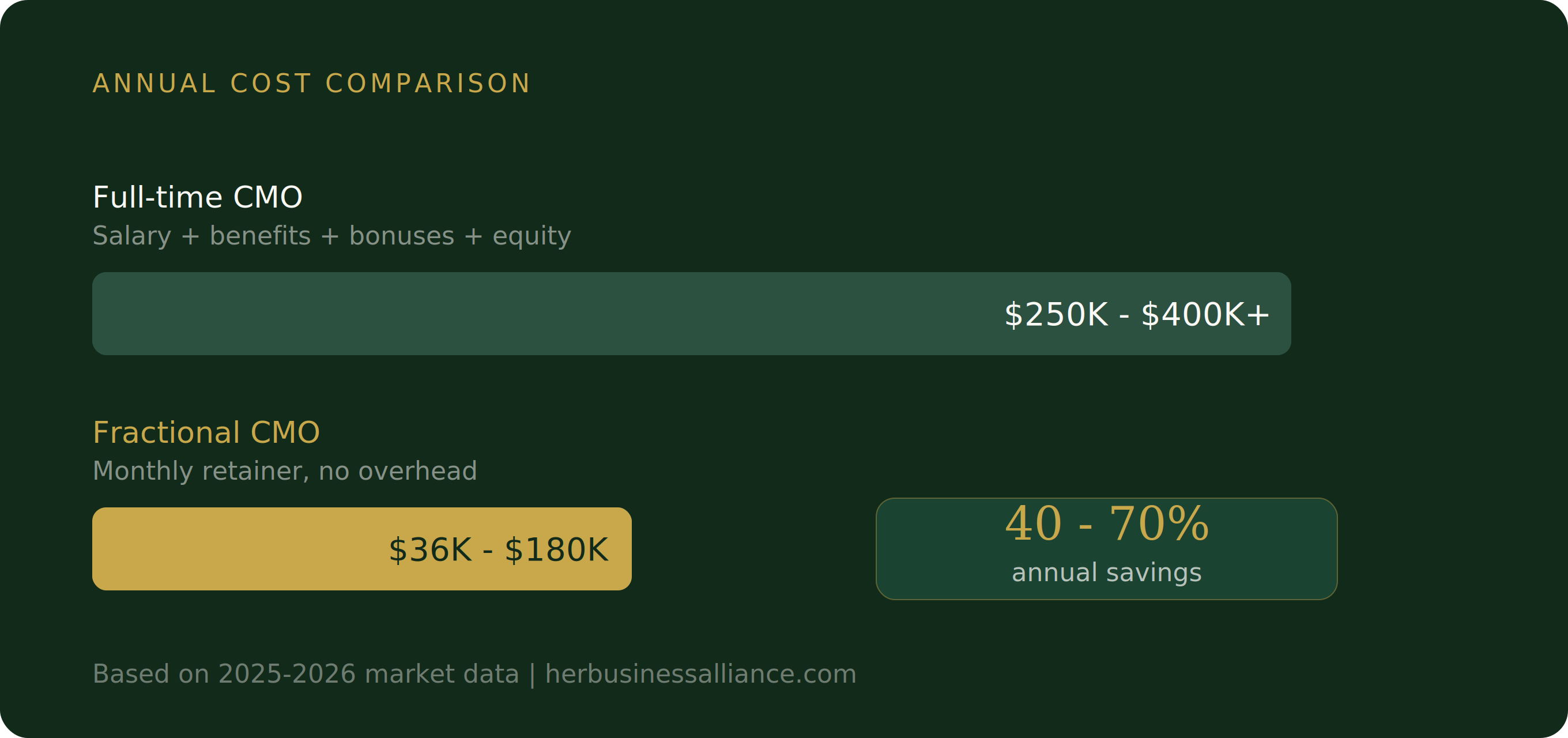
The comparison with a full-time marketing hire comes down to timing, budget, and what the business needs right now.
A full-time CMO or VP of Marketing makes sense when the business has scaled to a point where marketing is running complex, multi-channel operations that require day-to-day executive oversight, when the budget supports total compensation in the $250,000 to $400,000 range, and when the organization is large enough that a full-time leader has enough scope to fill their week.
For businesses that are earlier in their growth trajectory, that level of investment creates a mismatch. You're paying for full-time availability when you may only need 15 to 20 hours of senior strategic input per week. And filling those remaining hours often leads to a CMO getting pulled into tactical execution work that's below their expertise level, which is an expensive use of their time and a frustrating use of their talent.
Fractional marketing solves this by matching the investment to the actual need. You get the strategic depth and leadership experience, applied at the hours and pace that fit your current stage. As the business grows and marketing complexity increases, you can scale the engagement up, bring on additional fractional team members, or eventually transition to a full-time hire with the fractional leader's guidance on what that role should look like.
Who Is Fractional Marketing Right For?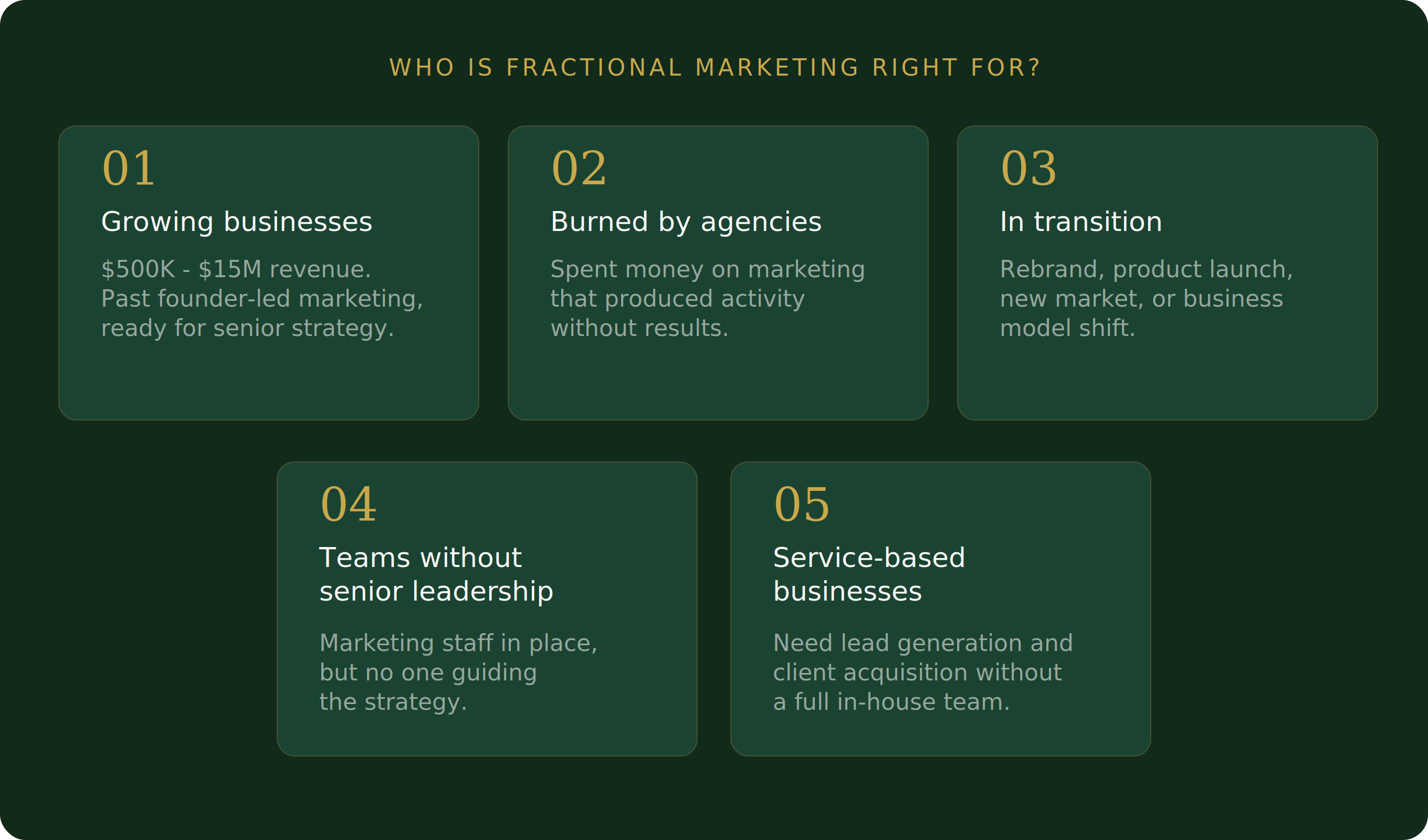
Fractional marketing is a strong fit for several types of businesses.
→ Growing businesses in the $500K to $15M revenue range that have outgrown founder-led marketing and need senior strategy to build a real growth engine. These businesses often have some marketing activity happening, whether it's social media, a basic website, or occasional ad spend, but lack the strategic architecture that ties it all together into a coordinated effort that produces predictable revenue.
→ Businesses that have been burned by agencies that produced deliverables without understanding the business's goals. If you've spent money on marketing services that generated activity without results, the missing piece is almost always strategic leadership, which is exactly what fractional marketing provides.
→ Companies going through a transition like a rebrand, a new market entry, a product launch, or a shift in business model. These inflection points require experienced marketing leadership to navigate successfully, but they're often time-bound, making a fractional engagement the right level of commitment.
→ Businesses with internal marketing staff that lack senior leadership. If you have a marketing coordinator, a social media manager, or a content writer on staff but no one guiding the strategy, a fractional CMO provides the direction your team needs to perform at a higher level.
→ Service-based businesses and professional services firms that need marketing to drive lead generation and client acquisition but don't have the volume or complexity to justify a full in-house department.
How Much Does Fractional Marketing Cost?
Fractional marketing pricing varies based on the scope of the engagement, the experience level of the professional, and the structure of the arrangement.
Fractional CMO retainers typically range from $3,000 to $15,000 per month, according to MarketerHire and Fisher Marketing 2025-2026 benchmarks. Hourly rates for fractional marketing executives generally fall between $150 and $500 per hour depending on specialization and track record. Project-based engagements for specific initiatives like a go-to-market strategy, brand repositioning, or marketing technology implementation can range from $10,000 to $50,000.
For comparison, a full-time CMO's total compensation (salary, bonuses, benefits, equity) typically falls between $250,000 and $400,000 or more per year according to Spencer Stuart's CMO Tenure Study and Glassdoor data. A fractional engagement delivering the same strategic value at $10,000 per month represents a cost of $120,000 annually, an estimated 40 to 70 percent savings.
The ROI calculation is straightforward. If a $10,000 monthly fractional engagement contributes to even a 15 to 20 percent increase in qualified leads or pipeline value, the return on that investment compounds quickly. And because fractional professionals arrive with established frameworks, playbooks, and vendor relationships already in place, the ramp-up time is significantly shorter than onboarding a full-time hire. Industry surveys from GTM 80/20 suggest that companies working with fractional CMOs report roughly 29% higher revenue growth compared to those without senior marketing leadership, and 91% of companies rate their fractional CMO's performance as exceeding expectations.
The Psychology Behind Why Fractional Marketing Produces Better Results
Most conversations about fractional marketing focus on cost savings and flexibility, and those are real advantages. But there's a deeper reason this model consistently produces strong results, and it comes down to how the relationship is structured.
When a business hires a full-time marketing leader, the dynamic can quickly shift toward internal politics, comfort zones, and the natural tendency to protect one's position. Full-time employees are often incentivized to:
- Build complexity to justify their role
- Expand their team and defend their budget
- Make decisions that serve the department's interests over the business's growth
That happens because their job security is tied to looking essential. And it can lead to marketing that protects a department rather than growing the company.
Fractional marketing leaders operate under different incentives. Their value is measured entirely by the outcomes they produce. That means:
- No political motivation to build unnecessary layers or overstaff a department
- Every recommendation, every campaign, and every dollar spent is evaluated through the lens of whether it's moving the business closer to its revenue goals
- The objectivity that's difficult to maintain in a full-time role is built into the fractional model by design
The best fractional marketing professionals also bring a behavioral understanding of how customers make purchasing decisions. Marketing strategy should be informed by:
- How people process information and evaluate options
- What triggers action and what causes hesitation
- Where friction in the buying process causes potential customers to disengage
This is the layer that separates marketing that generates attention from marketing that generates revenue. At Her Business Alliance, this psychology-driven approach is foundational to how we build marketing strategy for our clients.
How to Choose the Right Fractional Marketing Partner
Finding the right fractional marketing partner requires evaluating a few key areas.
Industry experience matters: A fractional CMO who has driven results in professional services will approach strategy differently than one who has spent their career in enterprise SaaS. Look for someone who understands your market's dynamics, buying behavior, and competitive landscape.
Look for strategy and execution range: Some fractional professionals focus purely on high-level strategy and hand off all execution. Others combine strategy with hands-on implementation. The right fit depends on whether you already have execution capacity in-house or need the fractional partner to deliver the complete picture.
Evaluate how they think about marketing in relation to business goals: The best fractional marketing professionals build strategies backward from revenue targets, customer acquisition costs, and lifetime value. They understand the psychology of how buyers make decisions, and they design marketing infrastructure that moves people through that process deliberately. Marketing that chases vanity metrics like impressions, followers, and clicks without connecting those to revenue is marketing that wastes money.
Ask about their approach to measurement and accountability: Strong fractional marketing leaders establish KPIs from the start and report on what's working and what needs adjustment on a regular cadence. Accountability is a core part of the value they bring.
Cultural alignment and communication style: A fractional marketing leader becomes part of your team, even if they're part-time. The relationship works best when there's a natural fit in how you communicate, make decisions, and work through challenges.
Written by Lydia Solis, MBA | Founder & Fractional CMO, Her Business Alliance
Her Business Alliance is a fractional CMO and marketing leadership firm specializing in psychology-driven, holistic marketing strategy. We work with businesses across professional services, construction and trades, beauty and wellness, SaaS and tech, e-commerce, and creative services to build marketing strategy that produces revenue and supports real business growth. Ready to see where your marketing is losing momentum? Start with a Marketing Friction Audit™ →